
Trees growing beside driveways, sidewalks, parking lots, and other hard surfaces often become some of the most valuable features of a property. They provide welcome shade, soften the appearance of pavement, improve curb appeal, and create a more comfortable environment around homes and businesses.
But these trees also grow under conditions that can be considerably more challenging than trees located in open lawns or natural wooded areas.
Limited root space, compacted soil, reflected heat, construction activity, vehicle traffic, road salt, drainage changes, and conflicts between roots and pavement can all influence long-term tree health. A tree may continue looking healthy for years while stress gradually develops beneath the surface.
For residential and commercial property owners throughout Andover, Sparta, Denville, Kinnelon, Blairstown, Morristown, Newton, Hackettstown, Randolph, Roxbury, and surrounding Northern New Jersey communities, trees located close to paved areas deserve careful monitoring and proactive maintenance.
At Global Shade Tree Professionals, we look at more than the visible canopy. We consider the tree’s roots, soil, growing environment, structural condition, nutrition, and surrounding property. This complete approach helps us identify developing concerns and recommend practical care that supports healthier, safer trees.
Hard Surfaces Change a Tree’s Growing Environment
A tree growing in an open landscape may have access to a broad area of relatively undisturbed soil.
Trees surrounded by pavement face very different conditions.
Driveways, sidewalks, parking lots, curbs, and buildings can limit the amount of soil available for roots while changing how water and air move through the ground.
These trees may experience:
- Limited rooting space
- Compacted soil
- Higher soil temperatures
- Reduced moisture availability
- Drainage problems
- Physical root damage
These conditions do not automatically mean a tree will decline. However, they make professional monitoring especially valuable.
Soil Compaction Is a Major Concern
Healthy roots require both moisture and oxygen.
When soil becomes heavily compacted, the spaces between soil particles become smaller. Water movement can change, oxygen availability may decrease, and new roots may have difficulty developing.
Compaction can occur from:
- Vehicles
- Construction machinery
- Repeated foot traffic
- Material storage
- Landscape equipment
Commercial properties are particularly susceptible because trees may grow beside busy parking areas and frequently used pedestrian routes.
Residential trees can experience similar problems when vehicles regularly drive or park over root zones.
Tree Roots Extend Far Beyond the Trunk
One common misunderstanding is that most roots remain directly underneath the canopy or close to the trunk.
In reality, important roots can extend well beyond the visible base of a mature tree.
This means driveway replacement, sidewalk installation, trenching, landscaping, and other property improvements may affect roots even when work appears to be a safe distance from the trunk.
Before significant excavation near mature trees, considering the root zone can help prevent unnecessary damage.
This is particularly important on established properties throughout Sparta, Morristown, Denville, and Kinnelon, where mature trees may have been growing long before current pavement or landscape features were installed.
Roots and Pavement Can Eventually Conflict
As trees mature, roots increase in diameter.
When large roots develop beneath pavement, property owners may eventually notice:
- Raised sidewalk sections
- Cracked pavement
- Uneven driveway surfaces
- Disturbed curbing
These situations require careful evaluation.
Simply cutting a large root may affect tree health or structural stability, depending on the location and importance of that root.
Tree-related pavement concerns should therefore be approached as both a property-maintenance issue and a tree-health issue.
Reflected Heat Can Increase Tree Stress
Pavement absorbs solar energy during hot weather.
Parking lots and driveways can become significantly hotter than surrounding lawns and garden beds. That heat can affect nearby trees, particularly when combined with limited soil moisture.
Trees growing in these environments may experience greater summer stress.
Young trees can be particularly vulnerable because their root systems are still establishing.
Proper species selection, watering, soil management, and professional monitoring can make a meaningful difference.
Drainage Patterns May Be Different Around Pavement
Hard surfaces prevent water from soaking directly into the soil.
Instead, rainfall flows toward surrounding areas.
Depending on grading, this can create very different conditions for nearby trees.
One tree may receive excessive runoff while another receives insufficient moisture.
Too much water can reduce oxygen around roots, while too little water can create drought stress.
Professional evaluation considers the entire growing environment rather than assuming every tree needs the same watering approach.
Road Salt Can Affect Trees Near Streets and Parking Areas
Winter introduces another challenge.
Salt and other deicing materials used around roads, sidewalks, driveways, and parking lots can sometimes reach nearby soil through runoff or spray.
Excessive salt exposure can affect plant health and soil conditions.
Trees and shrubs growing close to heavily treated surfaces may require additional monitoring.
Signs of environmental stress can include:
- Leaf browning
- Reduced growth
- Twig dieback
- Overall decline
Because similar symptoms can result from insects, disease, drought, and other causes, accurate diagnosis is important.
Branch Clearance Matters Around Vehicles
Trees near driveways and parking lots need appropriate clearance.
Low or poorly positioned branches may interfere with:
- Cars
- Delivery trucks
- Emergency vehicles
- Parking spaces
- Driveway access
- Visibility
Professional pruning can address clearance while preserving the tree’s natural structure.
The goal is not simply to remove every branch near pavement. Thoughtful pruning considers how the tree will continue growing after cuts are made.
Improper pruning can create long-term structural problems that are more difficult to correct later.
Walkway Trees Require Safety Monitoring
Trees beside sidewalks and pedestrian routes deserve particular attention because people regularly pass underneath them.
Professional inspections can identify concerns such as:
- Dead branches
- Cracked limbs
- Hanging branches
- Structural weaknesses
- Significant canopy decline
Routine care is especially valuable around schools, apartment communities, offices, retail properties, medical facilities, and other high-traffic environments.
Property managers throughout Morristown, Randolph, Roxbury, Newton, and Hackettstown can benefit from making tree inspections part of regular exterior maintenance.
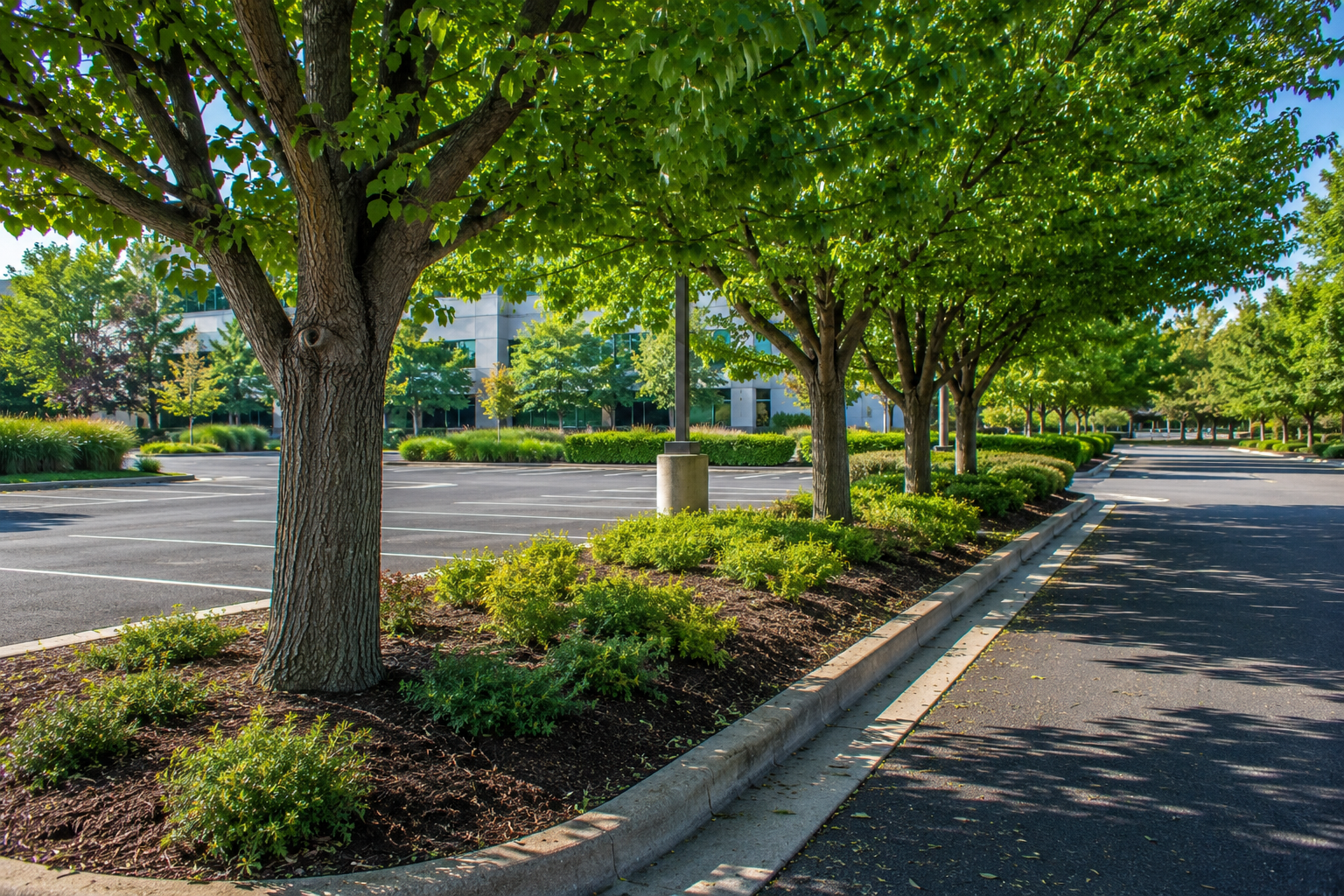
Parking Lot Trees Work Harder Than They Look
Parking lot trees provide tremendous benefits.
They create shade, reduce the harsh visual impact of pavement, and make commercial properties more inviting.
Yet parking islands can be challenging growing environments.
Trees may have limited soil volume and experience:
- Intense heat
- Compaction
- Vehicle damage
- Restricted root development
- Irregular moisture
- Snow storage
- Deicing materials
These trees often benefit from proactive professional care rather than waiting for visible decline.
Fertilization Can Support Trees in Challenging Sites
Trees growing near hard surfaces may not have access to the same nutrient cycling found in natural environments.
Leaves are often removed, soil may be disturbed, and roots compete with surrounding landscaping.
When appropriate, professional fertilization can support:
- Root development
- Healthy foliage
- Balanced growth
- Recovery from environmental stress
- Long-term vigor
However, fertilization should reflect the needs of the individual tree.
Applying nutrients without understanding soil and tree conditions is not a substitute for professional assessment.
Organic Pest Control May Be Part of the Solution
Environmental stress can make some trees more vulnerable to damaging insects.
A tree already struggling with compacted soil, root disturbance, or heat may have fewer resources available to respond to additional pest pressure.
Our organic pest control approach considers both the insect and the health of the host plant.
Professional monitoring can help identify:
- Unusual leaf damage
- Bark abnormalities
- Insect activity
- Branch dieback
- Premature leaf drop
The earlier developing problems are recognized, the more options may be available.
Construction Near Trees Requires Planning
Replacing a driveway, expanding a parking lot, installing a walkway, or repairing underground utilities can place mature trees at risk.
Potential impacts include:
- Root cutting
- Soil compaction
- Grade changes
- Trunk damage
- Changes in drainage
Ideally, valuable trees should be considered before construction begins.
Planning ahead may allow property owners to modify work areas or take precautions that reduce unnecessary tree damage.
Once major roots have been severed, the options become much more limited.
Shrubs Near Pavement Need Attention Too
Trees are not the only landscape plants affected by hard surfaces.
Shrubs surrounding driveways, entrances, sidewalks, and parking areas may experience similar problems involving heat, salt, soil compaction, and limited root space.
Professional shrub care can help maintain:
- Healthy foliage
- Appropriate size
- Clear walkways
- Better visibility
- Attractive entrances
Trees and shrubs should work together to enhance a property rather than interfere with how people move through it.
Tree Placement Can Affect Future Maintenance
When adding new trees to a landscape, planning ahead is extremely important.
A young tree may appear small enough to fit almost anywhere, but its mature size can be dramatically different.
Property owners should consider:
- Mature canopy width
- Root development
- Distance from pavement
- Nearby buildings
- Utility areas
- Available soil volume
Thoughtful placement can reduce future conflicts while giving trees better opportunities to thrive.
Commercial Tree Care Protects More Than Appearance
For businesses, trees around parking lots and walkways are part of the customer experience.
A well-maintained landscape can make a commercial property feel established, comfortable, and professional.
Tree maintenance also helps address practical concerns involving:
- Branch clearance
- Visibility
- Pedestrian areas
- Parking spaces
- Storm damage
- Long-term landscape costs
Routine inspections allow maintenance to be planned instead of relying entirely on emergency response.
Storms Can Increase Risks Around Hard Surfaces
Trees beside pavement frequently have valuable property directly beneath them.
A falling branch may damage a parked vehicle, block a driveway, or obstruct a commercial entrance.
Northern New Jersey’s thunderstorms, wind, snow, and ice can place substantial loads on mature branches.
Professional evaluations can identify deadwood and certain structural concerns before severe weather arrives.
No tree can be made completely storm-proof, but proactive maintenance can reduce avoidable risks.
Mosquito and Tick Management Complements Outdoor Property Care
Trees and shrubs around patios, walkways, commercial seating areas, and wooded property edges can create shaded outdoor environments.
During warmer weather, those same areas may also support mosquito and tick activity.
Professional mosquito and tick control, combined with appropriate shrub maintenance and landscape care, can help make outdoor spaces more comfortable.
This is especially valuable for properties with:
- Patios
- Play areas
- Outdoor dining
- Apartment common areas
- Wooded boundaries
Comprehensive property care considers both plant health and how people actually use the landscape.
Preventive Maintenance Helps Protect Mature Trees
The most effective time to address a tree problem is often before it becomes obvious.
Trees growing near hard surfaces should be monitored for changes such as:
- Canopy thinning
- Dead branches
- Root damage
- Soil compaction
- New leaning
- Pavement movement
- Reduced growth
- Insect activity
Routine professional tree care provides an opportunity to identify these concerns and develop an appropriate plan.
Preserving an established mature tree can often be far more valuable than waiting until severe decline makes removal necessary.
When Removal May Become Necessary
Not every tree located near pavement can be preserved indefinitely.
Removal may eventually become appropriate when:
- Structural stability is significantly compromised
- Root damage is severe
- The tree is dead or extensively declining
- The tree presents an unacceptable risk
- The site can no longer reasonably support the tree
Professional tree removal should be carefully planned, especially near buildings, vehicles, pavement, and pedestrian areas.
At Global Shade Tree Professionals, we evaluate the condition and surroundings of the tree before recommending the appropriate course of action.
Frequently Asked Questions
Can tree roots damage a driveway?
Large roots can sometimes contribute to pavement lifting or cracking as trees mature. The situation should be evaluated before roots are cut.
Is it safe to cut roots that are lifting a sidewalk?
Not automatically. Removing significant roots may affect tree health or stability. Professional evaluation is recommended first.
Why do parking lot trees sometimes decline?
Limited soil, heat, compaction, vehicle activity, irregular moisture, and winter deicing materials can all create challenging conditions.
Can pavement make tree roots too hot?
Hard surfaces can increase surrounding temperatures and contribute to heat stress, particularly during prolonged hot weather.
Should trees near sidewalks be inspected regularly?
Yes. Trees near pedestrian areas deserve routine monitoring because dead or damaged branches may affect frequently used spaces.
Can construction near a driveway damage trees?
Yes. Excavation and heavy equipment can damage or compact roots even when work does not directly touch the trunk.
Does fertilization help trees surrounded by pavement?
It may help when nutritional deficiencies or challenging soil conditions are present, but fertilization should be based on professional evaluation.
Can salt damage trees near roads?
Excessive exposure to deicing materials can contribute to plant and soil stress, particularly close to treated surfaces.
Should branches above parking spaces be removed?
Healthy branches do not automatically require removal simply because they extend above parking. Dead, damaged, poorly positioned, or structurally concerning branches should be professionally evaluated.
Why choose Global Shade Tree Professionals?
We provide comprehensive residential and commercial tree and landscape services throughout Northern New Jersey, including tree evaluations, professional pruning, tree removal, fertilization, shrub care, organic pest control, mosquito control, and tick control.
Give Trees Near Pavement the Specialized Care They Need
Trees surrounding driveways, sidewalks, parking areas, and commercial entrances provide enormous value, but they also grow in some of the most demanding locations on a property.
At Global Shade Tree Professionals, we help property owners look beyond the canopy and understand how soil conditions, root space, pavement, traffic, weather, pests, and maintenance decisions influence long-term tree health.
We proudly provide professional tree care, tree pruning, tree removal, fertilization, shrub care, organic pest control, mosquito control, tick control, and commercial tree services throughout Andover, Sparta, Denville, Kinnelon, Blairstown, Morristown, Newton, Hackettstown, Randolph, Roxbury, and surrounding Northern New Jersey communities.
Phone: 973-398-0682
Email: globalshadetree@aol.com
Contact Global Shade Tree Professionals today to schedule a professional tree evaluation and protect the trees that add shade, beauty, comfort, and lasting value to the most heavily used areas of your property.