
Trees are remarkably resilient. A mature tree can survive years of changing temperatures, heavy rain, dry periods, storms, and competition from surrounding vegetation. That resilience can sometimes give property owners the impression that established trees simply take care of themselves.
In natural forests, trees benefit from a continuous cycle of organic material. Leaves, twigs, and other plant matter fall to the ground, decompose, and gradually return nutrients to the soil. Residential and commercial landscapes operate very differently. Fallen leaves are removed, grass competes for resources, construction alters soil, and landscaped areas may contain soil that has been disturbed or compacted for decades.
As a result, even established trees can eventually experience nutrient limitations.
Across Andover, Sparta, Denville, Kinnelon, Blairstown, Morristown, Newton, Hackettstown, Randolph, Roxbury, and surrounding Northern New Jersey communities, professional tree fertilization can play an important role in maintaining healthy landscapes when soil conditions and tree health indicate additional nutritional support is needed.
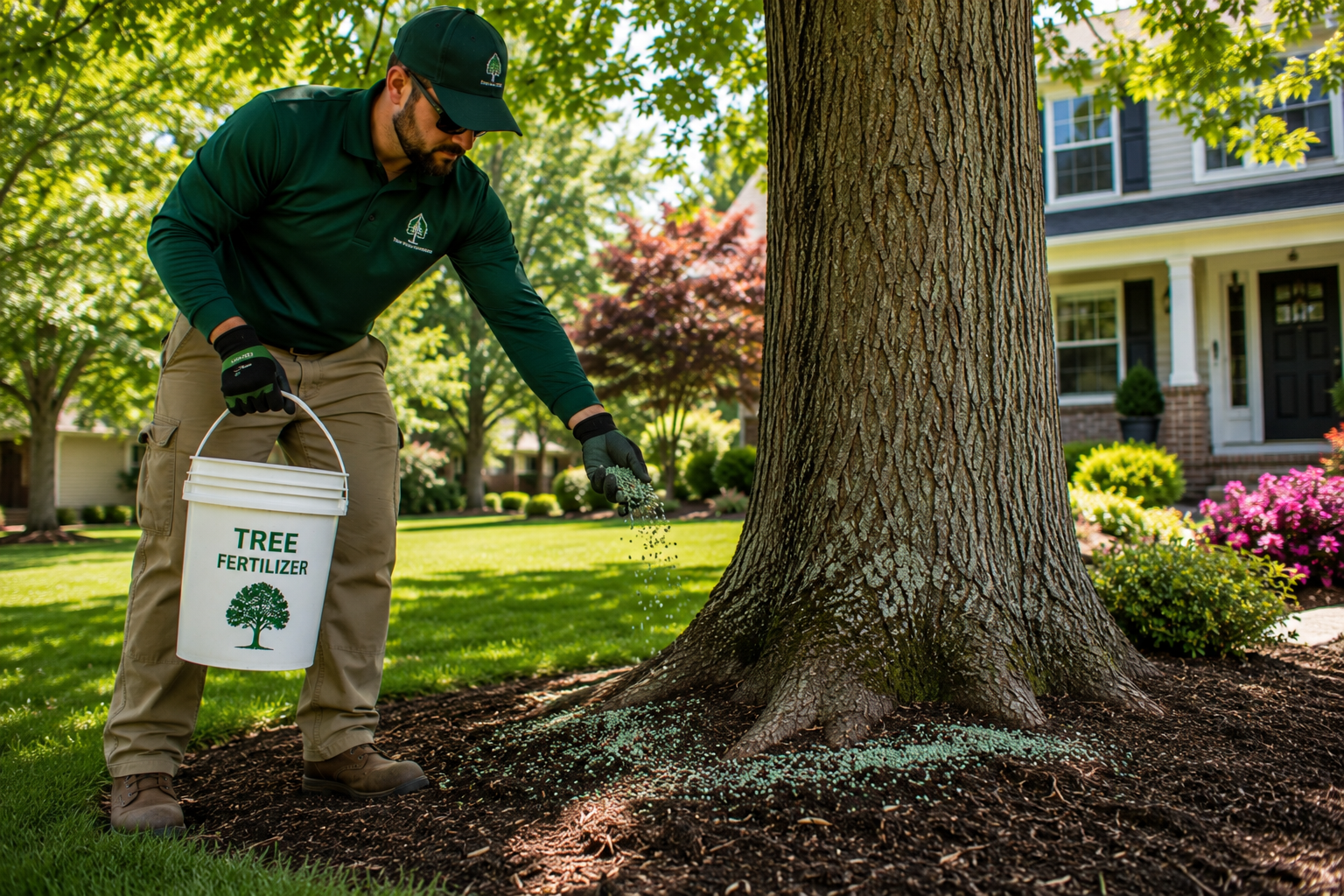
At Global Shade Tree Professionals, we do not believe every tree should automatically receive the same fertilizer. Professional tree care begins by understanding the tree, its environment, and the reason it is struggling. When nutrition is part of the problem, an appropriate fertilization program can support stronger roots, healthier foliage, and improved long-term vigor.
Trees Need More Than Water and Sunlight
Trees manufacture energy through photosynthesis, but they also depend on nutrients obtained through their roots.
These nutrients support essential processes involving:
- Root development
- Leaf production
- Energy storage
- New growth
- Flower and seed production
- Overall plant function
When the soil cannot provide appropriate nutrients, growth and appearance may gradually change.
The challenge is that many symptoms associated with nutrient deficiencies can also be caused by drought, insects, disease, root damage, or poor drainage.
Professional evaluation helps distinguish among these possibilities.
Pale Leaves Can Be an Early Warning Sign
One of the most noticeable indications of possible nutritional stress is a change in foliage color.
Healthy leaves should generally display the coloration expected for their species.
Property owners may notice leaves becoming:
- Pale green
- Yellow
- Unevenly discolored
- Less vibrant than in previous years
The location and pattern of discoloration can provide useful diagnostic information.
However, yellow leaves do not automatically mean a tree needs fertilizer.
Excessive moisture, root problems, insects, disease, and other conditions may produce similar symptoms.
That is why diagnosing the cause should come before selecting the treatment.
Smaller Leaves May Signal Reduced Vigor
Property owners who see their trees every day may not immediately notice changes in leaf size.
Over several growing seasons, however, a stressed tree may produce smaller foliage than it once did.
Reduced leaf size can be associated with:
- Nutrient limitations
- Root stress
- Drought
- Compacted soil
- Environmental pressure
When smaller leaves appear alongside thinning canopy growth or branch dieback, a professional tree evaluation becomes particularly valuable.
Slower Growth Is Worth Investigating
Mature trees naturally grow more slowly than young trees, so reduced growth does not automatically indicate poor health.
But a noticeable change from the tree’s established growth pattern may deserve attention.
Property owners may notice:
- Shorter new shoots
- Less canopy expansion
- Reduced foliage density
- Limited recovery following pruning
Tree growth should always be evaluated in context.
Species, age, weather, site conditions, and overall health all influence how quickly a tree grows.
A Thin Canopy Can Have Several Causes
A thinning canopy is one of the more visible signs that a tree may be under stress.
From a distance, property owners might notice more sky visible through the branches than in previous years.
Potential causes include:
- Root damage
- Drought
- Disease
- Insects
- Nutritional limitations
- Natural decline
Fertilizing without determining the cause may miss the real problem entirely.
At Global Shade Tree Professionals, we look at the complete tree—from the canopy to the root zone—before developing recommendations.
Soil Conditions Matter as Much as the Fertilizer
Fertilizer cannot compensate for every poor growing condition.
If soil is severely compacted, poorly drained, or otherwise unfavorable, roots may struggle regardless of how many nutrients are present.
Healthy tree soil should provide access to:
- Moisture
- Oxygen
- Nutrients
- Appropriate rooting space
Properties throughout Sparta, Denville, Kinnelon, and Morristown can contain soil that has been substantially altered during construction and landscaping.
Understanding these conditions is an important part of long-term tree care.
Construction Can Change Soil for Years
A home or commercial building may have been constructed decades ago, yet trees on the property can still be influenced by the way the land was originally graded.
Construction may involve:
- Heavy equipment
- Soil removal
- Soil compaction
- Grade changes
- Addition of fill
- Root disturbance
Later projects such as patios, driveways, utility work, and building additions can create additional changes.
Trees growing in these altered environments may not have access to the same soil conditions they would experience in a natural woodland.
Professional care takes this history into consideration whenever possible.
Lawns and Trees Compete for Resources
A beautifully maintained lawn and a large shade tree can coexist, but they also share the same soil.
Grass roots compete with tree roots for moisture and available nutrients.
Landscape maintenance can further alter the natural nutrient cycle when fallen leaves are routinely removed.
This does not mean property owners should stop maintaining their lawns.
It simply means landscaped trees sometimes require different care than trees growing in forests.
Mature Trees Can Benefit from Nutritional Support
Fertilization is sometimes incorrectly associated only with young trees.
Mature trees may also benefit when site conditions and tree health indicate a need.
An established tree can represent decades of growth and considerable landscape value.
Supporting that tree may help maintain:
- Healthy foliage
- Root activity
- Balanced growth
- Overall vigor
- Long-term landscape value
The objective is not to force rapid growth.
For mature trees, thoughtful care is usually about supporting health and resilience.
Young Trees Have Different Priorities
Newly planted trees face their own challenges.
Their root systems initially occupy a relatively small portion of the surrounding soil, making establishment especially important.
Young tree care should focus on:
- Appropriate watering
- Correct planting depth
- Proper mulch placement
- Structural development
- Root establishment
Fertilization may sometimes be appropriate, but it should not replace proper planting and basic establishment care.
A tree planted incorrectly cannot simply be fertilized into good health.
More Fertilizer Is Not Better
One of the most important principles of professional fertilization is moderation.
Trees do not benefit from unlimited nutrients.
Excessive fertilization may encourage undesirable growth or contribute to other plant and soil problems.
Professional programs consider factors such as:
- Tree species
- Tree age
- Existing health
- Soil conditions
- Landscape environment
- Nutritional requirements
The goal is balanced support rather than maximum growth.
Healthy Nutrition Can Support Root Development
Roots are the foundation of tree health.
They absorb water and nutrients while helping anchor the tree.
When nutritional conditions are appropriate, trees can devote resources to maintaining and developing their root systems.
Strong roots help trees manage environmental challenges such as periods of heat and limited rainfall.
This makes soil and root care an important part of preventive tree maintenance.
Tree Nutrition and Pest Pressure Can Be Connected
Trees under prolonged stress may become more vulnerable to certain damaging insects.
Poor nutrition is only one possible source of stress, but it can contribute to a broader decline when combined with:
- Drought
- Root damage
- Soil compaction
- Disease
- Construction activity
This is why fertilization and organic pest control should not be viewed as completely separate services.
When pest activity is present, we consider both the pest itself and the condition of the tree.
Improving overall plant health can be an important part of long-term management.
Shrubs Can Show Nutritional Stress Too
The same principles apply to ornamental shrubs.
Shrubs may develop:
- Pale foliage
- Poor flowering
- Weak growth
- Smaller leaves
- Reduced vigor
Professional shrub care considers soil, pruning, moisture, pests, and nutrition together.
A property where both trees and shrubs appear weak may have broader growing-condition concerns worth investigating.
Seasonal Timing Matters
Trees behave differently throughout the year.
Growth, root activity, energy storage, and environmental stress change with the seasons.
A professional fertilization program takes seasonal conditions into account rather than applying treatments solely according to convenience.
The appropriate timing depends on the individual tree, site, and treatment objectives.
This is another reason customized tree care provides more value than a one-size-fits-all program.
Commercial Trees Often Grow in Difficult Soil
Commercial properties can create particularly challenging environments for trees.
Trees may grow beside:
- Parking lots
- Sidewalks
- Building foundations
- Roadways
- Loading areas
- High-traffic walkways
Soil may be compacted, root space limited, and summer temperatures increased by surrounding pavement.
For commercial properties throughout Morristown, Randolph, Roxbury, Newton, Hackettstown, and surrounding Northern New Jersey communities, professional fertilization can be one component of a larger preventive tree care program.
Healthy commercial trees improve appearance while helping preserve valuable established landscaping.
Fertilization Works Best as Part of Comprehensive Care
Tree nutrition is only one part of tree health.
Depending on the property, comprehensive care may also include:
- Professional tree inspections
- Tree pruning
- Soil management
- Organic pest control
- Shrub care
- Tree removal when necessary
Outdoor property management may also include mosquito and tick control, particularly around wooded edges, patios, recreation areas, and commercial outdoor spaces.
By looking at the landscape as a complete system, we can address multiple factors affecting both plant health and property enjoyment.
Preventive Care Protects Long-Term Property Value
Mature trees cannot be replaced overnight.
Losing a large established shade tree can dramatically change:
- Property appearance
- Shade
- Privacy
- Outdoor comfort
- Landscape character
Preventive care helps property owners identify manageable concerns while there are still opportunities to respond.
Appropriate fertilization may represent a relatively small component of maintenance compared with the long-term value of preserving healthy mature trees.
Frequently Asked Questions
How can I tell whether my tree needs fertilizer?
Possible signs include pale foliage, reduced growth, smaller leaves, or canopy thinning, but these symptoms can have many causes. Professional evaluation is recommended before treatment.
Do all trees need annual fertilization?
No. Fertilization should reflect the needs of the individual tree and its growing environment.
Can fertilizer save a dying tree?
Fertilizer is not a cure for severe structural damage, advanced disease, major root failure, or other serious conditions. Accurate diagnosis is essential.
Can mature trees be fertilized?
Yes. Mature trees may benefit from nutritional support when soil and tree conditions indicate a need.
Should newly planted trees be fertilized immediately?
Not necessarily. Correct planting, watering, mulch placement, and root establishment are often the most important early priorities.
Can too much fertilizer damage trees?
Improper or excessive fertilization can create problems, which is why professional application and appropriate recommendations matter.
Does healthy soil reduce the need for fertilizer?
Healthy soil with appropriate nutrient availability can support trees naturally. Fertilization needs vary significantly between properties.
Can poor nutrition make trees more vulnerable to pests?
Trees experiencing prolonged stress may be less resilient against certain pests and environmental pressures.
Should commercial properties fertilize their trees?
Commercial trees growing in compacted, restricted, or disturbed soils may benefit from professional evaluation and customized fertilization.
Why choose Global Shade Tree Professionals?
We provide comprehensive tree and landscape care throughout Northern New Jersey, including professional tree evaluations, fertilization, pruning, tree removal, shrub care, organic pest control, mosquito control, and tick control. Our recommendations are based on the needs of the individual property rather than a one-size-fits-all approach.
Feed Your Trees What They Need—Not What They Don’t
A tree does not need to be visibly dying before its growing conditions deserve attention. Changes in foliage color, leaf size, canopy density, or growth can all provide early clues that something is affecting its health.
The answer is not always fertilizer. Sometimes the underlying issue is water, roots, insects, disease, soil compaction, or another environmental condition.
That is why professional evaluation matters.
At Global Shade Tree Professionals, we help homeowners, businesses, and property managers understand what their trees actually need and develop practical care strategies designed to protect valuable landscapes for the long term.
We proudly provide professional tree fertilization, tree care, tree pruning, tree removal, shrub care, organic pest control, mosquito control, tick control, and preventive landscape services throughout Andover, Sparta, Denville, Kinnelon, Blairstown, Morristown, Newton, Hackettstown, Randolph, Roxbury, and surrounding Northern New Jersey communities.
Phone: 973-398-0682
Email: globalshadetree@aol.com
Contact Global Shade Tree Professionals today to schedule a professional tree and landscape evaluation and give your trees the targeted care they need to remain strong, healthy, and beautiful for years to come.